Everybody Needs a Transportation Plan
Straight To The Point
Transportation plans do not guarantee success.
They establish vision, require commitment, and create accountability.
The plan itself is not the outcome.
The community it helps create is.
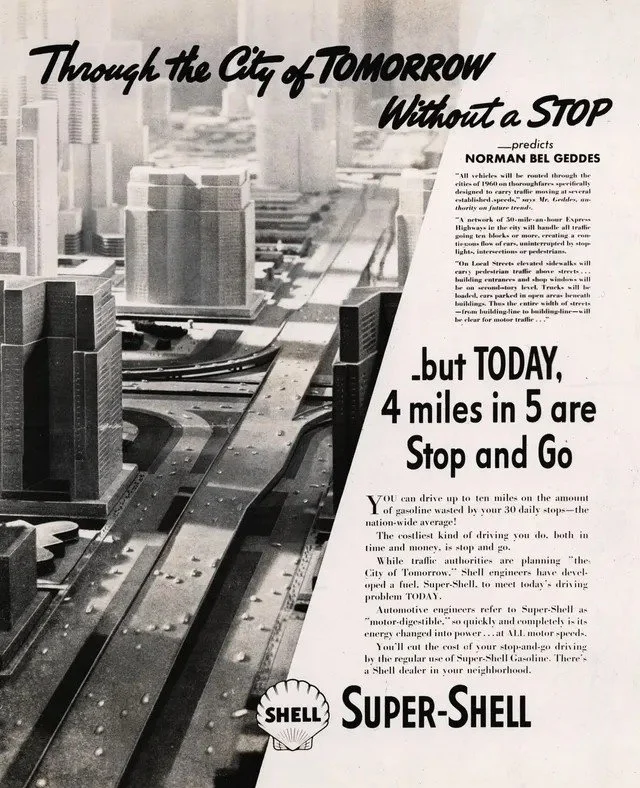
Image credit: Vanity Fair. Back to the Future: A New Look at Modernist Hero Norman Bel Geddes, Designer of the Original 1939 “Futurama”Looking beyond the map
Transportation plans have an image problem.
To some residents, they are long, confusing documents that collect dust while streets are choked by traffic.
To elected officials, they may feel like a relic that stands between ideas and accomplishment.
To local staff, they may be another document that requires an update every handful of years.
All of those perceptions may bear a measure of reality.
But they also miss the point.
The purpose of a transportation plan is not to make immediate change.
Nor is a plan about predicting the future.
It is a tool that helps communities prepare for it.
Every community is heading somewhere.
The real question is whether that destination is intentional.
Vision
Every transportation plan begins with a simple question:
What kind of community are we trying to become?
Safe?
Resilient?
Connected?
Prosperous?
Innovative?
Accessible?
These are not transportation questions.
They are community questions.
Transportation simply provides one layer of how we pursue those goals.
Without a shared vision, communities often make transportation decisions one project at a time.
One complaint at a time.
One crisis at a time.
Vision provides direction.
It gives decision-makers, staff, and residents a common understanding of what they are working toward.
Commitment
Vision is only the beginning.
A transportation plan establishes direction, but it rarely contains all the answers.
The most important work often begins after the plan is adopted.
Concepts are refined.
Alternatives are evaluated.
Studies are completed.
Designs evolve.
Projects are tested against real-world conditions.
New information emerges.
Sometimes the original concept proves feasible.
Sometimes a better solution is discovered.
Occasionally, the plan itself must adapt to new realities.
That's not failure.
That's commitment.
Commitment is the willingness to continue exploring the vision until it takes shape as something that can be implemented.
This process belongs to more than planners and engineers.
Policymakers play an essential role as well.
Priorities are debated.
Tradeoffs are considered.
Ideas are challenged.
Direction is refined.
Through this process, abstract goals gradually become actionable projects.
A transportation plan establishes the destination.
Commitment is the work required to discover the path.
Accountability
Vision establishes direction.
Commitment develops the path.
Accountability ensures the journey continues.
Without accountability, even the most thoughtful plan risks becoming shelf decoration.
A plan's value is not measured by its adoption.
It is measured by whether the community continues returning to it.
Are priorities reflected in decision-making?
Are projects advancing?
Are studies being completed?
Are designs moving forward?
Are investments aligned with the adopted vision?
Accountability is not about punishment.
It is about alignment.
It provides a mechanism for communities to periodically pause and confirm:
Are we still pursuing the future we said we wanted?
When circumstances change, accountability ensures adjustments remain intentional rather than accidental.
A transportation plan remains meaningful when it continues to inform the conversation long after adoption.
My Takeaways
In my experience, communities rarely struggle to generate ideas.
Often there are so many ideas that it becomes difficult to know where to begin.
Transportation plans do not make easy work of difficult decisions.
The hard work remains.
Testing and refining the vision.
Chipping away at the work incrementally.
Accepting wins, even when they were not your highest priority.
There will always be more projects than funding.
More needs than resources.
More opportunities than capacity.
Every community needs a transportation plan.
Not because transportation plans guarantee success.
They don't.
Communities need transportation plans because they establish vision.
They require commitment.
They create accountability.
A transportation plan does not tell a community exactly how it will reach its destination.
It does something equally important.
It helps ensure everyone is heading in the same direction.